
The Paradox of the Stick as a Weapon
A stick in stick fighting or La Canne obviously possesses no sharp edge, and in principle any part of the stick can strike the target. Nevertheless, we must consider the grip on the stick – the specific placement of palm and fingers – in order to generate impact in the most efficient manner.
Biomechanical Analogy with Swordsmanship
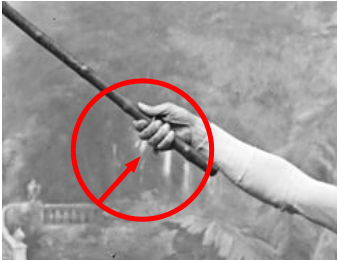
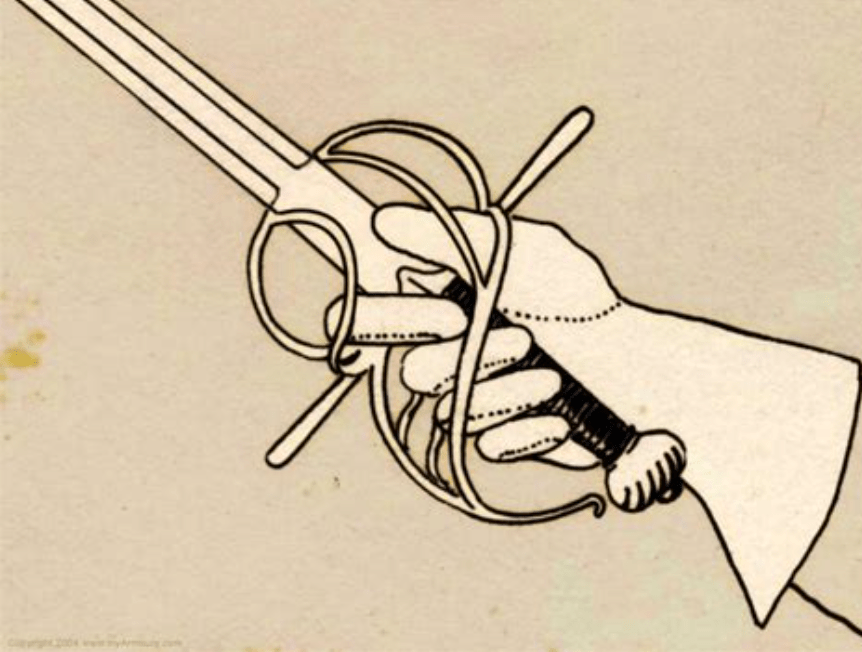
Universal Grip Principles
The correct placement of fingers and palm that we encounter in stick fighting is likewise found in the use of swords and all other weapons with a cutting edge. This correspondence is not coincidental, but based on fundamental biomechanical principles.
The Knuckle Line as Reference Point
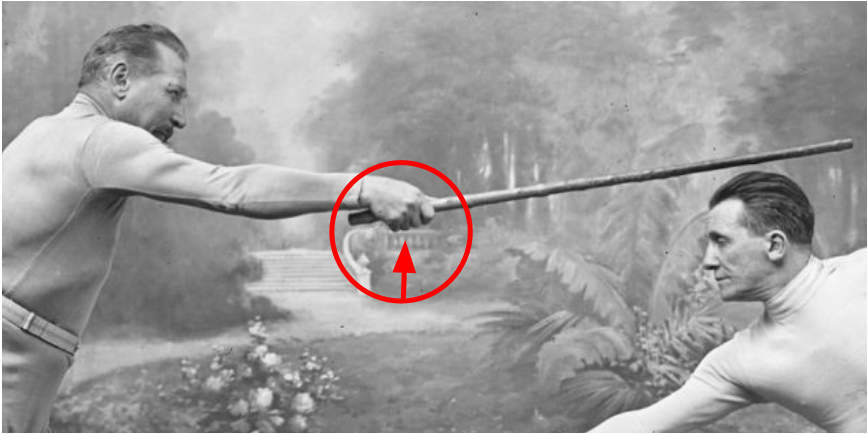
In both Western and Eastern traditions, a crucial rule applies: the second knuckles (counted from the fingertip) correspond with the sharp edge of the sword. This natural alignment optimizes force transmission and control.
In Renaissance Italian fencing treatises, “filo dritto” (true edge) refers to the edge of the sword that aligns with the knuckles of the sword hand. This is the primary cutting and parrying surface employed in the majority of offensive and defensive actions, as described by the classical Italian rapier masters.
The Concept of the “Virtual Cutting Edge”
Translation to Stick Fighting
The line formed by the knuckles thus provides an indication of how we can attack with the “sharp edge” of the stick to cause optimal impact on the target. This virtual cutting edge determines:
- Energy Transfer: Maximum force transmission to the target
- Control: Precise guidance of the stick during the attack
- Stability: Retention of grip upon impact
Fundamental Consistency
Universal Application
Although different nomenclatures are used to define stick strikes, fundamentally the same grip principles will always be employed. This universality underscores the biomechanical validity of the technique.
Practical Implications
- All effective stick techniques respect the knuckle-line orientation
- Variations in nomenclature do not alter the underlying grip structure
- The “sharp edge” remains constant, regardless of the specific attack technique
- Possible exceptions will confirm the rule
Historical Continuity
These grip principles represent an unbroken tradition extending from classical swordsmanship to modern stick fighting, preserving the essence of efficient weapon manipulation despite the change of weapon.

 Shobukai Dojo - Aikido & La Canne