Admiral Takeshita’s Secret Archive: How Three Lives Shaped Early Aikido
A reconstruction based on five primary sources: Ueshiba Morihei, Admiral Isamu Takeshita and Professor Kenji Tomiki, 1925–1931
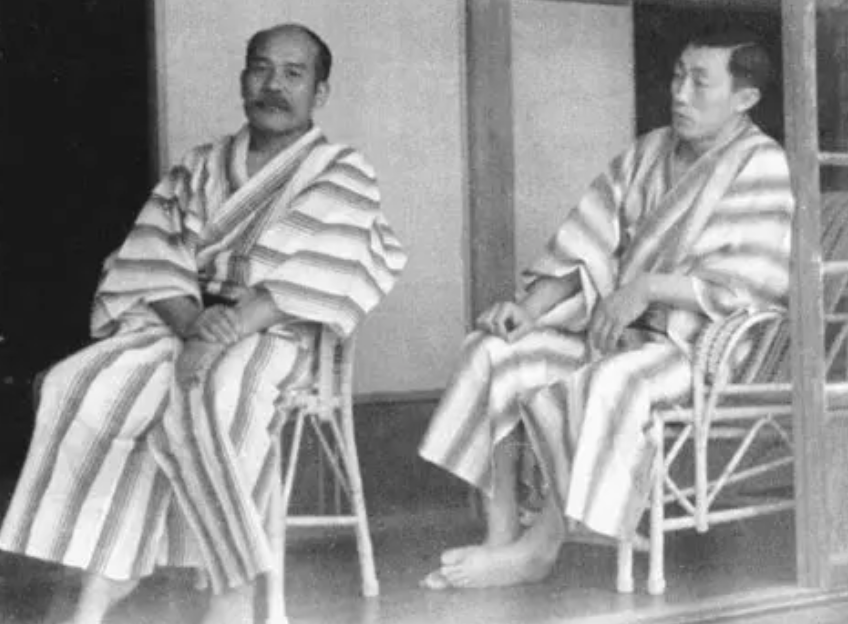
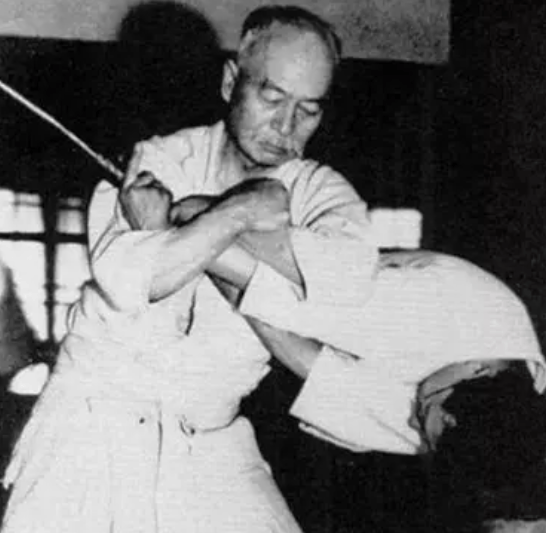
Anyone who takes the history of aikido seriously quickly runs into a problem: most accounts of the early years come from the founder’s own circle, published by his son Kisshōmaru, and are rarely checked against independent sources. In recent years this has begun to change, thanks to one remarkable historical figure whose notes were never intended for publication: Admiral Isamu Takeshita (1869–1949), naval officer, diplomat, and from 1925 until his death the most important patron of Morihei Ueshiba. His diaries and training notes today form the backbone of a scholarly revision of early aikido history — and, just as importantly, they lay bare for the first time the thread connecting Ueshiba, Takeshita and Kenji Tomiki, the man who would later systematize the art as Tomiki Aikido.
This article brings that dossier together.
- The Admiral and the Martial Artist
On December 1, 1925, a most unusual visitor called on Admiral Takeshita: Morihei Ueshiba, at that time still a relatively unknown martial artist from Ayabe, recommended by naval officers who had seen something extraordinary in him. Takeshita recorded it in his diary with a soldier’s matter-of-factness:
“Around eleven o’clock in the morning Asano, Ueshiba Morihei and Inoue Koichirō came to visit. He showed me the kata of Daitō-ryū jūdō. Extremely well researched — entirely worth training in. We agreed: starting tomorrow, I will begin.”
A note on the wording: on December 1, 1925, Takeshita literally wrote 大東流柔道 (“Daitō-ryū jūdō”) — not jūjutsu. Shishida suggests this was either a slip of the pen for jūjutsu, or the admiral’s own familiar label: as a former judo instructor (he had even taught judo to President Roosevelt), he simply recorded this unfamiliar jujutsu as “a kind of jūdō”. Over the following two weeks his naming shifted through 大東流柔術, 大東流, やわら (yawara) to aiki-jūjutsu — the term he then kept using consistently.
What followed was a relationship of 24 years, until Takeshita’s death in 1949. He trained fanatically himself, opened his home as a dojo, arranged housing and students, and introduced Ueshiba into the highest circles of prewar Japan: naval officers, aristocrats, politicians — and eventually the imperial palace itself, where Ueshiba gave his famous 21-day seminar in 1926.
Crucial is what Takeshita’s painstaking notes record about how Ueshiba referred to his own art in those years. In December 1925 Takeshita noted the names Daitō-ryū jūdō, Daitō-ryū, yawara, and from December 14 consistently aiki-jūjutsu — in short, in this period Ueshiba taught and presented his art as Daitō-ryū aiki-jūjutsu, the school of his teacher Takeda Sōkaku.
This is one of the great historiographical corrections from the diary, as Professor Fumiaki Shishida (Waseda University) demonstrated in 1992 in Budogaku Kenkyū. The traditional account of the Ueshiba family (an early renaming to “aiki-bujutsu”, the move to Tokyo in February 1927, the palace seminar in 1925) is inaccurate or imprecise:
- the name “aiki-bujutsu” was not publicly announced until June 14, 1929;
- the 21-day seminar took place in September–October 1926;
- the Ueshiba family moved to Tokyo in October 1927;
The renaming to “Aoi-ryū aiki-jūjutsu” (February 17, 1928) was not Ueshiba’s own initiative but a decision of the Aioikai, the support circle led by Takeshita — probably, according to Shishida, to spare Ueshiba the fear of his teacher Takeda. According to Kudō, the naming line then continued via “aiki-bujutsu” (1929) to “aiki-budō” (around 1931) — precisely the names Tomiki uses in his 1928 letter and afterwards.
- The 3,256 Techniques
Takeshita did not only record in his diary what he did; he also wrote down everything he learned. He compiled the notes covering 1925–1932; the systematic summary of 1930–31 received a telling title: “Aiki Jutsu Hiden” (The Secret Tradition of Aiki Techniques), in two volumes named after the classical hexagrams Ken (乾 = heaven, front) and Kon (坤 = earth, back):
Ken no Maki: 1,622 techniques against frontal attacks (grips on wrists, sleeves, chest; thrusts and strikes);
Kon no Maki: 1,634 techniques against attacks from behind, against weapons (knife, sword, spear, bayonet, staff, iron fan), against multiple opponents, against judo, and even against firearms.
Together, 3,256 techniques. The surrounding figures are just as revealing: 572 training days across 1925–1931, averaging 1 to 2 hours per day, roughly 1,000 hours of instruction in total. At an average of 5.7 new techniques or variations per training session, Ueshiba almost never repeated himself. To put that in perspective: over the roughly six years from December 1925 to the end of 1931, 572 training days come down to about 95 days per year — almost 8 sessions per month, or nearly twice a week, year after year. The name Ueshiba later gave his art — “Takemusu Aiki”, “the endless generation of techniques” — suddenly becomes, through this quantitative record, not a philosophical claim but a documented fact.
The linguistic finding is equally important: in Takeshita’s compilation “Aiki Jutsu Hiden” — literally “the secret transmission of the aiki techniques” (秘伝: hi = secret, den = transmission of what is handed down from teacher to student; a classic term for a school’s inner teachings) — the basic names of modern aikido — kotegaeshi, iriminage, kaitennage, tenchinage — appear nowhere as independent technique names. There are only the Daitō-ryū terms (ikkajo through gokajo), a few proper names (shihō-nage, koshi-nage, kokyū-nage), and a strikingly concrete, descriptive character in the notes: not names, but fully written-out chains of action per situation.
The commentary’s conclusion is unavoidable: the postwar, standardized aikido curriculum is a late construction. The system Ueshiba taught around 1930 was still explicitly Daitō-ryū in character: situational and descriptive. Only in the postwar styles (Aikikai, Yoshinkan, Tomiki) was that abundance organized into fixed names and series.
The quantitative distribution is equally revealing:
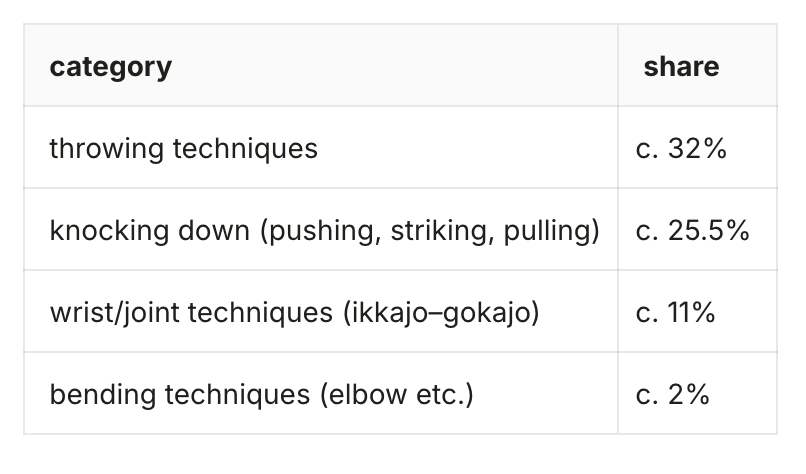
And: some 40–50% of all techniques contain atemi — a figure that illustrates Ueshiba’s words via Shioda Gōzō: “Aikido in practice is seven parts atemi, three parts throw.” Modern aikido, in which atemi has been almost entirely removed, therefore stands further from the original system than is often assumed.
- Tomiki in the Margins of the Archive
Then there is the third man in this story. For anyone reading the Takeshita sources, Kenji Tomiki appears at precisely the right places.
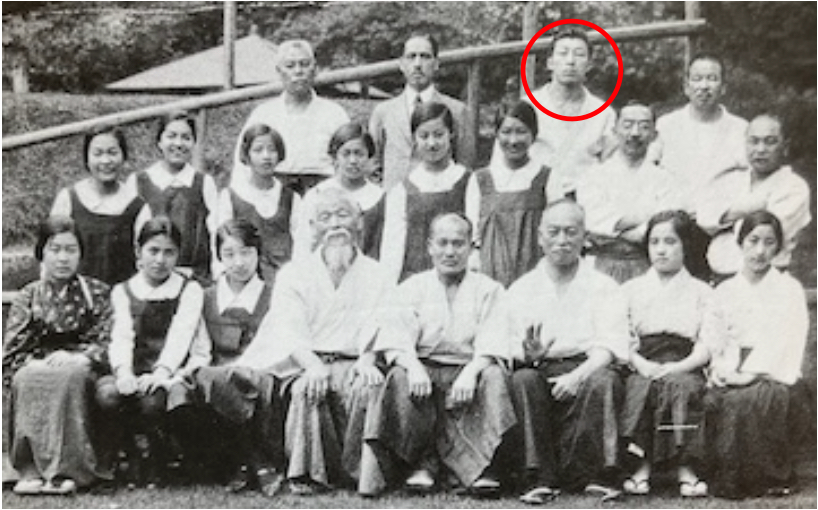
1926: on the photograph taken in 1926 at the Shimazu villa in Tokyo — Ueshiba with Admiral Takeshita and the first Tokyo students — Tomiki also stands at the back of the rear row. He was thus part of this circle early on.
1927: in the autumn Tomiki appears repeatedly in Takeshita’s diary (analyzed by Shishida and further dated by Kudō): a visit on September 28, training on November 14 together with, among others, Takeshita’s daughter Misao, Shimojo, Yamamoto and Yamaji, and on January 18, 1928 the moment of interruption: “Tomiki stops because of military service.” Tomiki thus trained for over a year side by side with the admiral himself. In Tomiki’s own later words: three weeks in Ayabe with Ueshiba in the summer of 1927, then with the family to Tokyo in October 1927, and “director and assistant” of Takeshita’s Aioikai.
1928: on September 19, 1928, Tomiki writes his long letter to Takeshita from Hirosaki (the original runs to 17 sheets of letter paper and is preserved via the Takeshita family with Daitō-ryū head Katsuyuki Kondo; transcription by Professor Shishida from 1991, English translation Christopher Li, published by Aikido Journal). Takeshita’s diary notes receipt on September 21: “Received Tomiki’s views on aiki-jūjutsu from Hirosaki — his comparison with Kodokan judo is interesting.” Earlier, in May 1928, Tomiki had already written a substantively similar letter to the writer Kaishū Nakazato: this line of thought was no one-time impulse. That second letter survives in full (reproduced in Takedani Ryuzen’s Nakazato Kaizan and Martial Arts as “Personal Views on Martial Arts”) and contains the same core — budō as one path, Kodokan judo as a limited sport, and the famous phrase “kata that is simultaneously randori” — supplemented with points of his own: Daitō-ryū as an ideal martial art for women, and the complete Daitō-ryū lineage copied from the scroll he had received from Ueshiba.
That letter is in essence the first programmatic document of what would later become Tomiki Aikido — written by a 26-year-old conscript, eleven years before the first 8th dan (1940), and twenty-six years before the book Judo Taiso (1954), whose term Tomiki did not yet use: in the prewar sources the vocabulary is still that of aiki bujutsu.
A note on that military service: no document states its length explicitly, but it can be reconstructed from the sources. Tomiki stopped training on January 18, 1928 (Takeshita’s diary), so he was drafted in early January. Posted to the headquarters of the 31st Regiment, 6th Battalion in Hirosaki (8th Division), he writes on September 19 that after the closing maneuver — the grand maneuvers at Shinkyō, moved up for the Shōwa enthronement ceremonies of November 1928 — “only a bit over a month of army life remains”. Discharge therefore fell around late November/early December 1928: roughly eleven months of service, fitting his rank of officer candidate of the intendance (経理部幹部候補生), a shortened, specialized conscription rather than the full two years. Immediately after discharge he returned to Tokyo and Ueshiba’s circle, and in 1929 he represented Miyagi Prefecture at the Imperial Martial Arts Tournament.
- The Letter as a Founding Document
What Tomiki lays out in his letter of September 19, 1928 to Takeshita is a complete line of thought:
Budō is one path. Kendō and jūjutsu are ultimately expressions of the same way; advance and retreat, posture and breathing must correspond. That modern judo and kendo are growing apart is, for Tomiki, the first sign that something is wrong with modern budō.
Kodokan judo is irrevocably a sport. With a sharp analysis of the groundwork controversy (Dai-ichi vs. Dai-ni High School): within the logic of sport, Dai-ni was right, and Kanō’s reproach (“cowardly for shinken-shobu”) missed the point — modern judo is sport. Yet Tomiki does not reject it: as sport it functions excellently. A word of explanation: the “Dai-ichi vs. Dai-ni” controversy concerned the inter-school judo matches between the First and Second Higher Schools (the elite preparatory schools of the imperial universities, the same world that later produced Kōsen judo). Dai-ichi had by far the stronger team on paper — a 3rd dan and a whole row of black belts — yet kept losing to Dai-ni, which rarely had more than one or two black belts but trained groundwork (ne-waza) fundamentally: on the ground there is nothing left to attack. Kanō’s verdict was harsh: groundwork belonged after an opponent had been fully overwhelmed, to control a second one; using it from the start was “cowardly” for shinken-shobu. Tomiki, schooled in the ethos of the day, confesses that he felt Dai-ni’s behavior was underhanded — but in theory, he concludes, they were absolutely right: within the agreed rules of a sport, exploiting the opponent’s weakness is rational. Behind it lay a hard training arithmetic: standing throwing technique takes three or four years to yield real skill, whereas groundwork combined with physical strength produces significant results within six months to a year — the efficient route for anyone competing to win.
“They are kata that are themselves randori.” Tomiki tests Ueshiba’s jujutsu against Kanō’s four purposes of judo (taiiku-hō, shushin-hō, ishin-hō, goshin-hō) and arrives at the core observation: although the teaching is kata-oriented, these are not fixed forms but flexible, situational patterns — “kata that are themselves randori”. And the weakness of a randori emphasis (degeneration into favorite techniques and muscle power) dictates the sequence: first maturation through kata, then randori.
A note on those four purposes, as Kanō himself formulated them: taiiku-hō (体育法, the method of physical education — harmonious, all-round bodily development), shushin-hō (修心法, the method of cultivating mind and judgment — the ability to observe, grasp a situation and act on principle), ishin-hō (育心法/意志法 in various readings, here the cultivation of will and aesthetic feeling — the ideal of beauty in movement, which Kanō considered inseparable from efficiency), and goshin-hō (護身法, the method of self-defense). In Kanō’s design, judo had to serve all four at once; testing Ueshiba’s art against this quadruple standard is therefore a much sharper experiment than a mere comparison of techniques — and Ueshiba’s jujutsu, precisely because its kata remain flexible and situational, passes all four at once.
Ueshiba’s religiosity is a separate matter. Tomiki was openly skeptical about Ōmoto-kyō, yet recognized that Ueshiba’s level might only be reachable through faith: “budō shugyō ultimately returns to faith.” A distinction he would maintain throughout his work: technique and method analytical, the spirit religious.
What stands out: here stands the future creator of “randori aikido” — with competitive forms — in 1928 on the side of kata! The formulation is more precise, however: the core of Ueshiba’s system is that the kata are flexible — not dead forms, but randori in kata form. Read from the outside only, the phrase suggests a paradox: kata is the structured form par excellence, randori the training form born of chaos — how can the one “be” the other? The paradox dissolves once it is clear that Tomiki does not mean “randori” here as a training form, but as a property of the kata themselves. The question is not whether one practises randori inside a kata, but whether the kata anticipates randori: a “fixed” kata drills the answer to one frozen scenario, a kata-that-is-randori drills the principle that works in any arbitrary situation. Structure is therefore not opposed to chaos, it covers it: the order is designed to run ahead of the open, unpredictable exchange. Precisely that design criterion — not the form itself, but the reach of the form — Tomiki will make the yardstick of his own work. The letter’s historical significance is that here, in a single paragraph, the seed of Tomiki’s later solution can be read: to order the kata so that the transition to randori becomes possible without degeneration. That precisely these two poles — kata and randori — form the compass of his later Judo Taiso, Randori no Kata and competition system makes this letter the oldest programmatic document of Tomiki Aikido.
A note for those who value detail: the published English translation contains a small error (“departing twenty-one days from tomorrow”), correctable through OCR of the Japanese transcription: Tomiki departs on September 21, two days after writing. His rank also appears in the letter: officer candidate of the finance/intendance department (経理部幹部候補生).
- The Line Takeshita → Shishida → Now
The reception history of this dossier deserves its own section. The “Takeshita line” does not run through the Ueshiba family, but through an academic chain:
The diaries and notes were preserved and made accessible via the Takeshita document research group (including Masaru Hatano).
Professor Fumiaki Shishida (Waseda University, professor of the intellectual history of Japanese budō, himself a shihan of the Japan Aikido Association and co-author, with Tetsurō Nariyama, of the standard work on Competitive Aikido) transcribed both the diary parts (1992) and the letter (1991), and built the empirical foundation of research into the formation of aikido.
His student Ryūta Kudō continued that line with a master’s study (Waseda, 2007), a quantitative analysis of the 3,256 techniques (Sport Science Research 12, 2015) and an article on Tomiki’s prewar theory of technique, which reconstructs the 17-sheet letter and the chain of existence of Tomiki’s system (letter 1928 → Kyotei 1937 → article series 1938 → Techniques in Separated Posture 1942) (Waseda Journal of Human Sciences, 2016).
In 2007 the transcription committee published “Aiki Jutsu Hiden”; as of 2026 the complete dossier — with commentary and letters — circulates through, among others, Aikido Journal.
The circle is remarkably symmetrical: Takeshita, the man who recorded Ueshiba’s art and gave it a stage, also created the environment in which Tomiki flourished — and the modern scholarly unlocking of that entire dossier is being done by the school of the man who continues Tomiki’s system.
- What This Dossier Shows
If we place Aiki Jutsu Hiden (1930–31), Shishida’s diary analysis (1992) and Tomiki’s letter (1928) side by side, a picture emerges that differs sharply from classical aikido historiography:
Ueshiba’s early system was not “aikido” but a Daitō-ryū foundation. Concrete, situational, without fixed technique names, and with an utterly practical outlook (c. 40% atemi, series against weapons and multiple opponents).
Takeshita’s role was constitutive, not decorative. Without the admiral no Tokyo period, no Aioikai, no palace seminar, no archive — and therefore no historical correction of postwar myth-making.
Tomiki’s system is not a break with Ueshiba’s original teaching, but an answer to it. In his first letter (1928) he formulates precisely the problems (kata vs. randori, sport vs. shinken-shobu, budō as one path) that would govern his life’s work — with the “Hiden” as the source material that lay before him.
Today’s aikido, in all styles, is a developmental layer on top of a richer source. What Tomiki calls “kata that are themselves randori” we find in the 3,256 situations of Aiki Jutsu Hiden in its most original form.
The continuation of this story falls outside this article’s time frame, but one bridge towards it deserves mention: at Kenkoku University in Manchuria, where Tomiki taught aikibudo from 1938 as a required subject alongside judo and kendo, he finally gave Ueshiba’s nameless, situational teaching its own descriptive names — oshi-taoshi, hiki-taoshi, kote-hineri, kote-gaeshi, shomen-ate — precisely the rationalizing vocabulary whose seed lies in the 1928 letter. These are the direct forerunners of the postwar Tomiki nomenclature.
For the Tomiki community this dossier provides a firm foundation: the competitive, systematic Tomiki Aikido does not historically stand against the original Ueshiba line, but is its most extensively documented direct continuation — in sources that neither Ueshiba nor Kisshōmaru ever saw, but which an admiral dutifully kept.
Sources
◎合気術秘伝:乾之巻・坤之巻(翻刻・句読点校訂版).pdf — transcription of Takeshita’s notes 1930–31 (3,256 techniques) with commentary by ed. Kenichirō Ayuai.
Fumiaki Shishida, “「海軍大将竹下勇・武術日記」と大正15年前後の植芝盛平 — 合気道の形成過程の研究(1)”, Budogaku Kenkyū 25-2, pp. 1–12, 1992.
Kenji Tomiki, letter to Isamu Takeshita, September 19, 1928; English translation Christopher Li, published by Aikido Journal; Japanese transcription Fumiaki Shishida (1991), from a copy provided by Katsuyuki Kondo.
Kenji Tomiki, “Personal Views on Martial Arts”, letter to Kaizan Nakazato, May 1928; reproduced in Takedani Ryuzen, Nakazato Kaizan and Martial Arts (Volume 2).
Ryūta Kudō, “合気道史における海軍大将竹下勇の覚書『乾』、『坤』(1930-1931年)の研究”, Sport Science Research 12, 2015, pp. 145–169; and master’s thesis, Waseda University, 2007.
Ryuta Kudō, “The Process of the Formation of Tomiki’s Pre-War Theory of Aiki-jūjutsu Techniques”, Waseda Journal of Human Sciences 18-1, 2016.
Kisshōmaru Ueshiba, Aikido Kaiso Ueshiba Morihei Den (1977), as the principal representative of the corrected “classical” account.
Eddy Wolput, November 2026

