A blog article about two overlooked texts by Kenji Tomiki, and what two modern historians teach us about the sense and nonsense of “traditional” martial arts.
Hardly a week goes by without the debate flaring up again somewhere on social media: is aikido “real”? Can you still call a martial art a martial art if there is no competition in it? Or is competition precisely the end of everything that makes budo authentic?
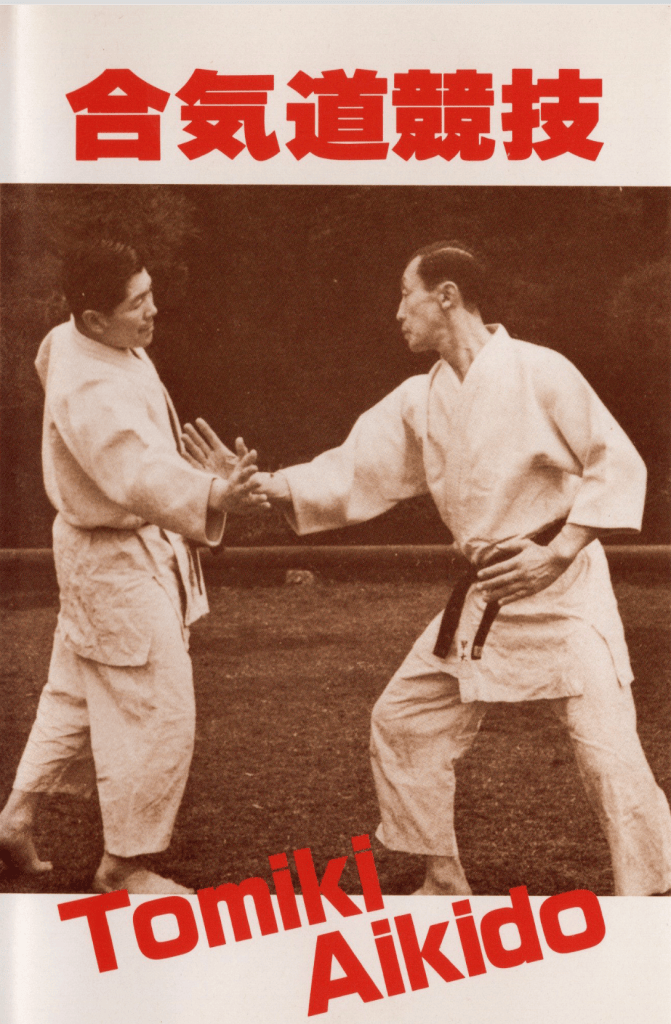
What most participants in that debate do not know is that this very question was already thought through thoroughly some eighty years ago, by someone who had every right to answer it: Kenji Tomiki (1900–1979), judoka, aikidoka, and the only person ever to stand in high regard with both Jigoro Kano and Morihei Ueshiba. In two relatively unknown texts, On Jujutsu and its Modernization and Modernization of Martial Arts—Its Significance and Method, he explains why the modern martial art needs a competition arena of all things, and why that is not a betrayal of tradition but its fulfilment.
Judo and aikido: two halves of the same inheritance
Tomiki begins with an observation that still surprises today: judo and aikido are not rivals, but complementary heirs of the same ancient jujutsu schools. The old schools knew four groups of techniques: nage-waza (throws), katame-waza (holds and controls), atemi-waza (strikes) and kansetsu-waza (joint techniques). Modern competition judo took over mainly the first two. The atemi and kansetsu techniques were left over, and it is precisely those techniques that live on through aikido.
The problem: in judo, throws and holds had matured through Kano’s randori method, while the striking and joint techniques fossilised after the Meiji Restoration. Nobody had ever systematically classified them, nobody had analysed them according to Kano’s three principles, and nobody had designed a training method for them. They remained stuck in their “bloodthirsty” old jujutsu meaning, while in reality they are refined means to topple or control someone without injuring him.
That, in a nutshell, is the programme of Tomiki’s life’s work: to give the atemi-waza and kansetsu-waza the same modern treatment that Kano had given the throws. His curriculum follows a logical ladder: solo exercises (tandoku undo), partner exercises (sotai undo), then ridatsu ho, the method of breaking away from a grip combined with an atemi, then seigyo ho, controlling with a joint technique, and finally randori ho, with the famous kata of seventeen techniques as a stepping stone to free practice and tournaments.
The core: kata and randori belong together
The heart of Tomiki’s argument is that kata and randori are not opposites but one system. Randori is indispensable because you only experience the principles of the martial art against “a clever, resisting and aggressive opponent”. Kata is indispensable because the dangerous techniques that cannot safely enter randori gain their depth there, and because kata is the ideal lifelong practice for older students. Whoever does one without the other gets stuck: randori alone turns budo into a contest of strength, kata alone turns it into a museum.
And then the philosopher in Tomiki
Both texts culminate in the same line of thought: the path runs from waza (technique) to mugamae (true natural posture) and mushin (the quieted mind). That is not new age, but the old conclusion of every serious training tradition: perfecting the technique is perfecting the spirit. Even Kano’s three principles, natural posture, gentleness and balance breaking, are in essence gateways to that same inner state.
The modernisation: from battlefield to arena
The second, more philosophical document explains why that training methodology is an ethical necessity. The old martial arts, Tomiki argues, were born on the battlefield: places “where lives seek to deny and erase other lives”. Training for the battlefield presupposes exposing yourself to mortal danger, and that clashes head-on with the modern educational ideal of respect for life. The solution is not to deny the techniques, but to replace the arena: the battlefield traded in for the competition mat, under rules and with etiquette.
What changes in the process is the meaning of “wa”, harmony. The old wa had to be enforced by force once dialogue was closed: the “life-giving sword”, killing one to save many. The modern wa exists from the first handshake: opponents who improve each other through rivalry and shake hands after the final decision as friends of the heart. The arena, Tomiki writes, is precisely for that reason such a valuable educational environment: nowhere do emotions run higher, and nowhere do you learn to control and purify them better.
Self-defence gets a modern twist too. A nation that has to teach self-defence to all its citizens betrays, in truth, a lack of morality and rule of law. Moreover, “violence” in the modern world must be read broadly: traffic, disasters, human-made calamity. Thus self-defence becomes safety education, and budo becomes a subject within physical education. The ethics of the new budo combines the vertical line of one’s own tradition with the horizontal line of international sportsmanship, and cuts out the feudal remnants: narrowness, conservatism and dogmatism may go; sincerity, courage, etiquette and modesty stay.
What the historians add
What Tomiki advocated from within the dojo has meanwhile been described academically as well, and the combination is enlightening.
Denis Gainty, in Martial Arts and the Body Politic in Meiji Japan (2013), wrote the history of the Dainippon Butokukai, the mass “Martial Virtue Association” of 1895 that connected the bodies of millions of Japanese with the nation. Gainty shows the path budo did not choose: in 1939 the martial arts became compulsory in primary schools, and in 1942 the Butokukai became a state organ with the Prime Minister as president and more than three million members. Where Tomiki wants to make the body a pedagogical instrument, the Butokukai made it a political instrument: the vitality of the individual became the barometer of the vitality of the empire. In that light, Tomiki’s post-war modernisation is not merely a training question, but a demilitarisation and democratisation of budo.
Raúl Sánchez García, in The Historical Sociology of Japanese Martial Arts (2019), describes the whole process through the lens of Norbert Elias: the civilising effect of rules, the reduction of violence, the sportisation of combat arts. And he confirms Tomiki almost literally: “the idea was to ‘modernise’ aikidō in the same vein that Kanō had modernised old-style jūjutsu”. But he also adds the uncomfortable chapter: before 1945 Tomiki taught aikido in Manchuria, at Kenkoku University and the military police, at the request of General Tojo. The man who after the war wanted to detach budo from the battlefield had sat in the middle of it. Someone who knows both worlds writes precisely the texts that Tomiki wrote.
It is interesting to see how the post-war aikido world responded to that same experience. The mainstream, around Kisshomaru Ueshiba, retold aikido as an “art of peace” and rejected any thought of competition. Tomiki chose the opposite answer: precisely because ethics is only real when something is at stake, the arena has a moral function. Both answers came out of the same war. One of them became world famous. The other remained a minority tradition, mainly in England, Australia, the United States, and among us, the Tomiki community in Europe.
What we can do with it
For anyone practising aikido, judo or another budo today, these texts hold three lessons that have lost none of their relevance.
First: “traditional” is a choice, not a fact. Every generation decides anew what is preserved and what is cut. Kano cut, Tomiki systematised, the Butokukai mobilised. The question is never whether you modernise, but towards what.
Second: competition is an ethical instrument, not a commercial sell-out. Anyone who reads Tomiki understands that a tournament is not an imitation of war, but a school in emotional control, under rules that anchor respect for life. The mat is the arena where “wa” is not enforced but practised.
Third: kata and randori are each other’s condition. In an era when one half of the budo world only wants to spar and the other half only wants to run through forms, the oldest modern insight may be the most current: only together do they lead from technique to mushin.
Tomiki wrote his texts for the reconstruction of a broken country, convinced that the old treasures were worth saving, provided they were translated into the language of modern life. That work of translation is never finished. Every practitioner who steps onto the mat, and every teacher who builds a lesson plan, continues it. From battlefield to competition arena: the journey is still under way.
Sources: Kenji Tomiki, “On Jujutsu and its Modernization” and “Modernization of Martial Arts—Its Significance and Method”; Denis Gainty, “Martial Arts and the Body Politic in Meiji Japan” (Routledge, 2013); Raúl Sánchez García, “The Historical Sociology of Japanese Martial Arts” (Routledge, 2019).

