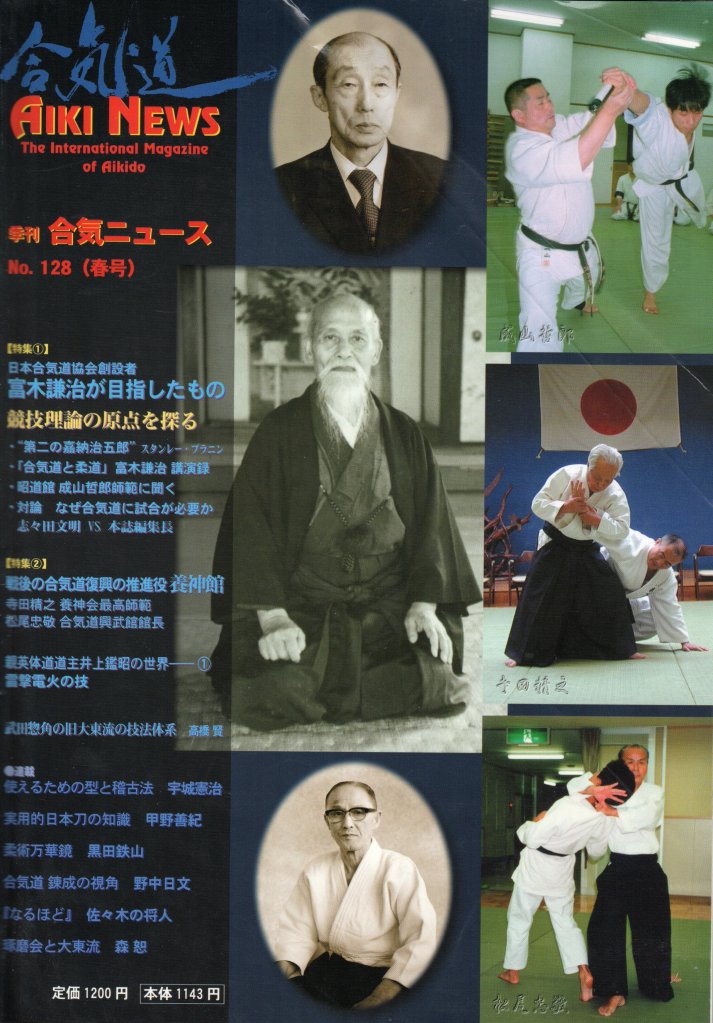
What Kenji Tomiki Was Really Aiming At
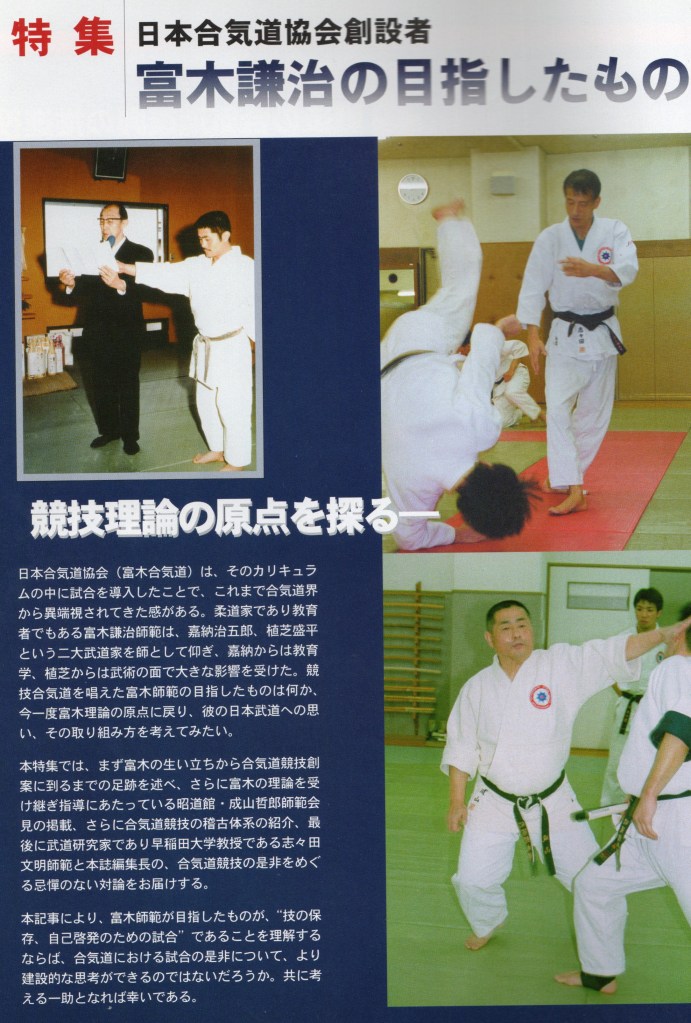
Aiki News no. 128 (2001) appeared as a special feature under the title “富木謙治の目指したもの” — “What Kenji Tomiki Was Aiming At”. Read the feature from cover to cover and you discover that competition was never the goal, only a means. An overview of five insights the feature still has to offer us today.
Anyone who practices Tomiki aikido knows the accusation: “you’re turning aikido into a sport”. What makes this feature — compiled by Stanley Pranin, with an interview of Tetsuro Nariyama and a discussion between Fumiaki Shishida and Pranin himself — so remarkable is that it does not refute that accusation by shouting louder, but by going back to the source: what did Tomiki actually want?
- “A Second Jigoro Kano”
Pranin opens with a bold thesis: of all the students of Morihei Ueshiba, Tomiki was the only one who could interpret the old jujutsu, aikido included, both historically and pedagogically. Where Ueshiba lived his budo religiously, Tomiki thought as a scholar and an educator. The guiding thread of his entire life is Kano’s question: how do you make a lethal art transmissible to everyone — without it remaining lethal?
The answer is classic judo thinking: what can be done safely, you practice in randori; what is too dangerous, you preserve in kata. Tomiki’s step was radically simple: why should that splitting principle not apply to judo as a whole, in the broad sense Kano had in mind? Kano himself had never managed to cast atemi-waza and kansetsu-waza into a competitive form. In Ueshiba’s aiki-jujutsu, Tomiki saw precisely that missing part: “judo at a distance” alongside “judo in the grip”. Anyone who looks at Tomiki from the aikido side alone forgets that he remained, above all, a judoka — with a fifty-year relationship with the Kodokan up to his 8th dan in 1971.
- The 1950 Lecture: The Missing Link
The most surprising part of the feature is an accompanying text: a lecture by Tomiki from 1950, also published at the time in the Aikikai’s own magazine. In it Tomiki does not yet speak about competition — at that point he is working on his “judo gymnastics”. But the core idea is already fully present.
Wherever there is humanity, Tomiki says, there is conflict, and from conflict fighting arts were born; the greatest task of our time — certainly for a Japan that had renounced war forever — is not to let that heritage slip away. There are two paths: the competition method and the “gymnastics method”: giving the kata exercise scientific and medical grounding, and systematizing it. Kano had intended both; only the competitive path was ever completed. The gymnastics path was Tomiki’s own project — a mission born out of his wartime internment and later maturing at Waseda as Judo Taiso.
For readers who know my translations of Tomiki’s papers, this text is a link between the early spirit of his letter to Takeshita (1928) and the aiki-randori-ho of the 1950s. The same obsession: budo is one path; “kata that is at the same time randori”.
- Why the Knife?
Nariyama’s interview clears up a practical question that is rarely explained: why Tomiki aikido scores with a rubber knife (tanto) rather than with bare hands.
In the first experiments with toshu-randori (bare-handed randori), judoka simply had too great an advantage: seoi-nage was permitted, and whoever had judo only needed to get inside. The solution: give the attacker a knife — the distance beyond judo’s reach (ma-ai) becomes the norm, and the criticism from the judo teachers disappears by itself. The rule attached to the knife is that only toshu techniques score points — inspired, of all things, by the scoring rules of volleyball.
The interview is full of such concrete details of origin: the kaeshi-waza came from a sumo bout (Tochi-Akagi turning the tables on Mienoumi), Tomiki briefly used the name “dai-ni judo” (“second judo”) before “new aikido”, and in November 1972 the JAA, Shioda’s Yoshinkan and Kisshomaru’s Aikikai stood together on a single tatami — organized by Sasakawa Ryoichi, who made it a condition that all aikido traditions appear together. Aiki history rarely offers a photograph as precious as that.
- The Tomiki Side of Kobayashi
For anyone who, like me, trained for many years with Hirokazu Kobayashi, this interview is gold. At Tomiki’s explicit instruction, Nariyama spent about six years with Kobayashi in Osaka: “Don’t just teach at Kobayashi-san’s place — learn from Kobayashi-san what I learned from Ueshiba-sensei.”
This is the Tomiki side of the Kobayashi story, which until now we knew mainly through the Aikikai line: Kobayashi’s techniques “bit” — a different, sharper colour than the control-without-pain approach of Tomiki and Ohba. The chain runs via Masamichi Abe (a Waseda alumnus and pioneer of aikido in France), who introduced Kobayashi to Tomiki. Interesting for the meguri research: this is the historical bridge between Kobayashi’s screw-like movement (meguri) and Tomiki’s system — two worlds that are still often regarded as separate.
- Shishida’s Mirror
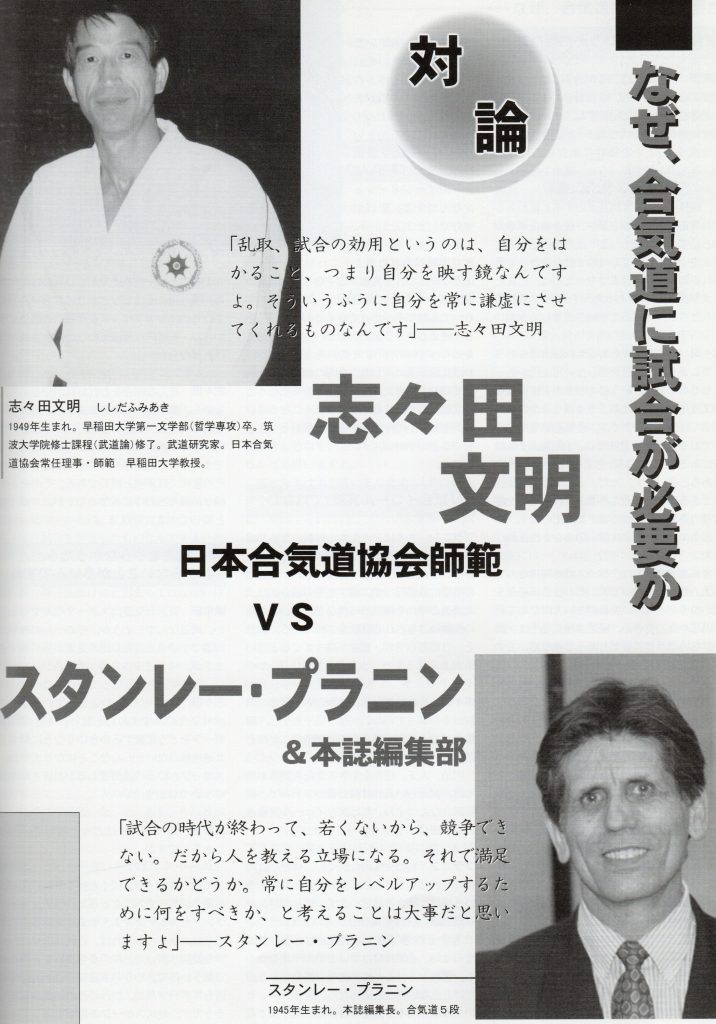
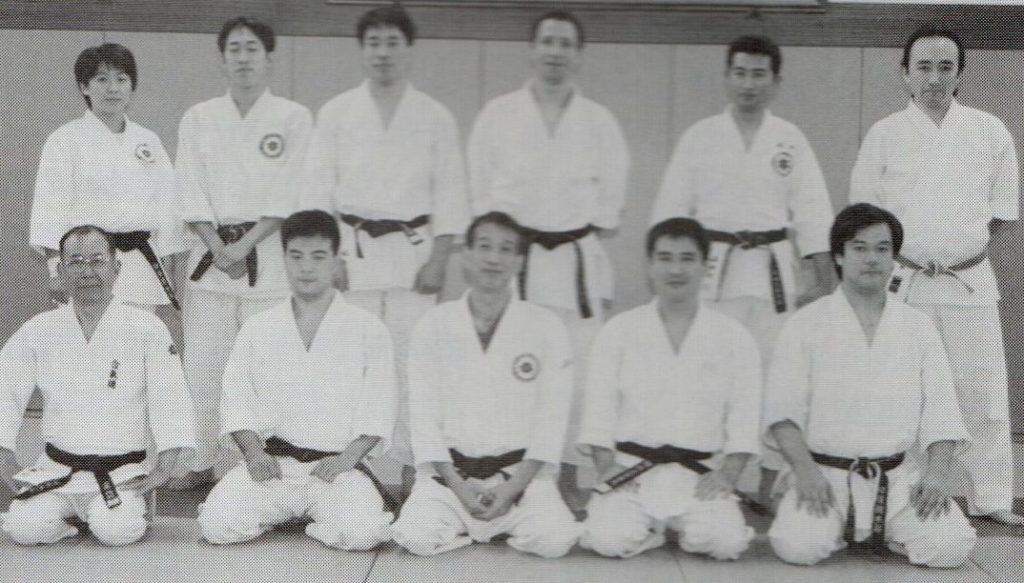
Pranin recorded this conversation at Waseda University in Tokyo. In its wake, an exchange of views on techniques also took place in the Waseda dojo, captured on video by Christiaan Gaddum, a member of the Shobukai dojo in Antwerp — so this is not only a printed feature: a visual document of the encounter also exists (YouTube).
The concluding dialogue is a defence of competition, but perhaps not the way you would expect. Shishida frankly calls competition a necessary evil: “necessary” because it is the only place where you measure yourself honestly, “evil” because it breeds a winning-at-all-costs attitude. You don’t abolish a good system because some people misuse it — you don’t abolish the car because of traffic accidents.
His finest image: randori and shiai are a mirror. Kata without a mirror becomes a mould; the mirror without kata has nothing to show. “Train randori as kata, and kata as randori.”
And the historical parallel that many critics forget: kendo went down exactly the same road. When real combat disappeared, the kata remained — along with the anxiety over whether it “still worked”. The answer was bogu and randori-kendo, at first criticized by kendo teachers themselves, later the standard alongside kata. Tomiki aikido, then, is not a historical anomaly, but repeats on a smaller scale a pattern every modern Japanese budo has gone through.
In Conclusion
What was Tomiki aiming at? Pranin sums it up in a single sentence: the preservation of technique, and competition as a means of self-cultivation. Competition is not the end of aikido, but an attempt to keep it alive. One may disagree about that — the feature invites precisely that conversation.
Sources: Aiki News no. 128 (2001), special feature “富木謙治の目指したもの” (What Kenji Tomiki Was Aiming At), with texts by Stanley Pranin, a 1950 lecture by Kenji Tomiki, an interview with Tetsuro Nariyama, and a conversation between Fumiaki Shishida and Stanley Pranin (recorded at Waseda University, Tokyo). Video of the exchange of views on techniques at the Waseda dojo: YouTube (excerpt from a longer video) — Christiaan Gaddum (Shobukai, Antwerp). Translation and processing as part of the Tomiki aikido research project (2026).

