From Dai-ni to BJJ: How One Sporting Logic Created Two Martial Arts
The groundwork controversy from Tomiki’s 1928 letter, followed through a century: from Dai-ni High School via Kōsen judo and Maeda to Brazilian jiu-jitsu — and why Tomiki’s kata/randori solution is the third answer to the same question
- The Starting Point: The Letter of September 19, 1928
In his letter to Admiral Takeshita, Kenji Tomiki articulated something that was already an old wound in 1928: the opposition between standing work and groundwork, and beneath it the deeper question of what judo actually is.
The occasion was the contest rivalry between the First and Second Higher Schools (Dai-ichi and Dai-ni Kōtō Gakkō). Dai-ichi had by far the stronger team on paper — a 3rd dan and a whole row of black belts — yet kept losing to Dai-ni, which rarely counted more than one or two black belts and trained groundwork (ne-waza) as its foundation: on the ground, no space remains in which to be thrown. Kanō Jigorō himself judged harshly: groundwork belonged after the first opponent had been fully overwhelmed, in order to control a second; deploying it from the very start was “not proper for shinken shobu — extremely cowardly”.
Tomiki’s analysis is double and honest:
Emotionally he shares the verdict of his generation: Dai-ni’s behavior was “underhanded”.
In theory Dai-ni was absolutely right: modern Kodokan judo is a sport; within the agreed rules, winning is the only criterion, and exploiting the opponent’s weakness is rational, not cowardly. Shinken-shobu falls “outside the equation”.
And with the sobriety of the future academic he adds the training arithmetic: standing throwing technique takes three or four years to yield real skill; groundwork, combined with physical strength, produces significant competitive results within six months to a year. For anyone who wants to win, groundwork is the most efficient route.
The letter closes by noting that this problem is “a continuing problem, even today” — in 2026, an understatement of a century. Precisely that drawn-out character is the theme of this essay.
- The Rule History: How the Sporting Logic Built Its Own System
2.1 Kōsen judo: the Dai-ni Position Institutionalized
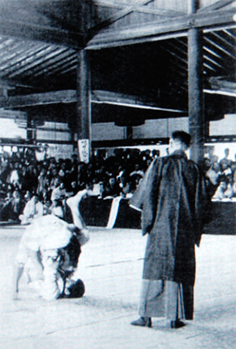
What Dai-ni was doing in the contest halls of the higher schools in the 1910s–1920s was no side phenomenon but the start of a separate tradition. In 1920 the Kōsen taikai (the championships of the imperial universities) began, with judo rules that favored groundwork: a throw at the edge of the mat was not stopped by stepping out, engagements on the ground were allowed to continue, and much of the fighting took place from the knees. Seven imperial universities dominated the tournament; their teams trained ne-waza as their core and developed for it a refined rule philosophy that still lives in Japan today as Kōsen judo.
The paradoxical result is exactly what Tomiki predicted: a completely legal, highly effective, victory-oriented style of play dismissed by the established judo world as “cowardly” or “not real judo”. Institution versus logic: the institution adjusted the rules to discourage groundwork, and the sporting interest kept finding the gaps in the new rules. Every rule that wants to keep the game winnable simultaneously creates the moment when the win-optimizing style adapts once more.
It is important to see clearly what happened here: judo, through its own sportification, had created a splitting pressure. The sporting logic calls for the style that wins — groundwork. The pedagogical and civic doctrine (Kanō’s shinken-shobu ideal, standing work, “jū” as the yielding way) calls for the style that forms character. The two could no longer coexist in one undifferentiated practice. Someone was bound to think that split through to its conclusion one day. It happened — but not in Japan.
2.2 Maeda: The Dai-ni Logic as a Profession
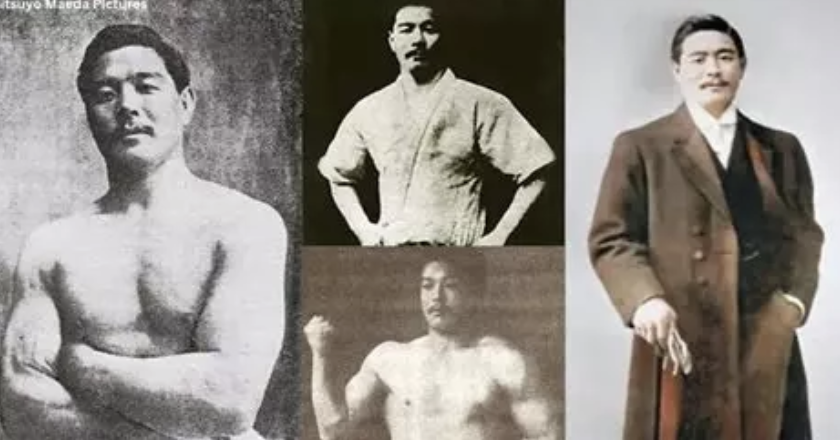
Mitsuyo Maeda (1878–1941), a Kodokan fourth dan, left for the United States in 1904 and became a professional fighter. What he learned in the US and Europe gave Tomiki’s analysis a bitter reality: in an “anything goes” context, the one who can dictate the fight wins — and whoever can take the fight to the ground can settle it there. He had learned groundwork thoroughly in the Kodokan (the Kodokan possessed that knowledge all too well: in the early 20th century the Kodokan remained undefeated in challenge matches precisely through its ne-waza); abroad, that knowledge proved to be his best currency.
From around 1914 Maeda settled in Belém, Brazil. Under the name “Conde Koma” he fought challenge matches and taught judo/jujutsu. Around 1917 the young Carlos Gracie became his student; his brother Hélio Gracie, of a lighter and frailer build, developed the system further with his nephews in exactly the direction the sporting logic already indicated: technique, leverage and ground positions over athletic throwing work, because that was the route by which a lighter practitioner could defeat a bigger one.
What BJJ was, therefore, from the very beginning, is the Dai-ni position driven through to an independent system: ne-waza not as a side phenomenon of judo, but as a complete martial art with its own structure (positions such as guard/mount/back, passing, submissions), its own training methodology and its own contest logic.
2.3 The Split Made Final: The Gracie Rules
A word on Vale Tudo (“anything goes”) first: the name covers the open, virtually rule-free challenge fights held in Brazilian circuses, clubs and, later, stadiums from the 1920s onwards — no weight classes, no time limits, no forbidden techniques: punches, kicks, headbutts, elbows, chokes and joint locks were all permitted, and the fight ended only with knockout, submission or a corner throwing in the towel. For the Gracie family these matches were both the proof and the marketing instrument of their system: in the 1920s–1930s under Carlos and Hélio, and again in the waves of the “Gracie Challenge”, the family invited boxers, wrestlers, capoeira fighters and representatives of any other style to test their art under these conditions. Vale Tudo thereby became the historical hinge where the Dai-ni logic of 1928 was verified in “real” conditions: when rules fall away, the fight gravitates to the clinch, the takedown and the ground — exactly the territory the Gracies knew best. The format culminated in the 1990s in the Vale Tudo events broadcast on Brazilian television and finally in PRIDE and the UFC, which made “no-holds-barred” a global formula.
The Vale Tudo fights and the “Gracie Challenge” of the 1920s–1990s made the fully open fight the marketing instrument of the system, and the BJJ contest rules rewarded what was sport-effective: a points system that rewards conquering positions (pass, sweep, mount, back) and allows submissions to the very end. In this sense BJJ truly is “the sporting logic of 1928 consistently driven through”: for a century it has honed its rules toward what wins from a dominant position — not toward what looks “honorable”.
That is not a reproach but precisely the interesting point. From 1925 the Kodokan used its contest rules to curtail groundwork (later it also restricted kneeling starts); it retained the shinken-shobu ideal as a pedagogical halo, but its contest product evolved into standing throwing work. Judo and BJJ are thereby two answers to the same question of 1928: judo chose the Kanō line (standing, throwing, formative ideal, rules that restricted groundwork), BJJ chose the Dai-ni line (groundwork, positional control, results).
- The Tomiki Hinge: The Third Answer
But there is a third answer, and it is already contained in the letter of 1928. What fascinated Tomiki about Ueshiba’s jujutsu was not that it somehow circumvented groundwork, but that it answered the splitting pressure itself: “kata that are themselves randori.”
That phrase reads like a paradox. Kata is the structured form par excellence; randori — literally “seizing chaos” — is the training form born of disorder. BJJ practitioners know the poles firsthand: the drill is choreographed, the roll is not. But the paradox dissolves once “randori” is understood here not as a training form but as a property of the kata themselves. The question is not whether one practises randori inside a kata, but whether the kata anticipates randori: a fixed kata drills the answer to one frozen scenario, a kata-that-is-randori drills the principle that works in any arbitrary situation. Structure is not opposed to chaos — it covers it. For readers of the BJJ world the analogy is immediate: the guard system is exactly that, a fixed order designed to run ahead of the unpredictable exchange; nobody calls playing guard a paradox because the positions answer chaos rather than deny it.
The parallel is more precise than it first appears:
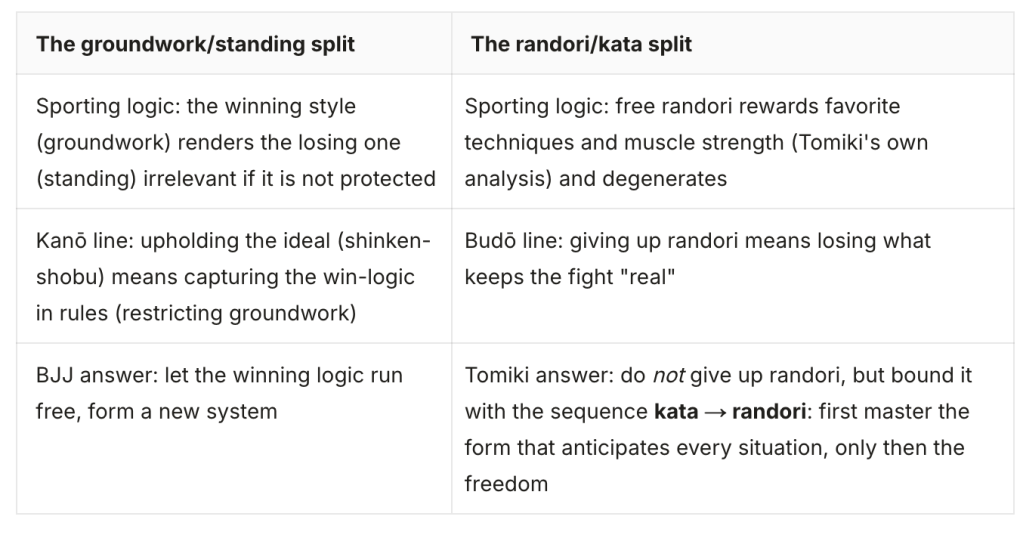
Tomiki’s sentence about Dai-ni must be read this way: he saw in 1928 that within the sporting logic the ideal cannot be preserved unpunished — his conclusion, accordingly, was not “back to shinken-shobu” but “look for a system in which sport and formation do not exclude each other”. He found that system (provisionally) in Ueshiba’s jujutsu, and it became his life’s work: to order the kata in such a way that the transition to randori becomes possible without degeneration. The sequence, in his own words of 1928: “first maturation through kata, then randori.”
In modern terms: judo solved 1928 with rules, BJJ solved it with differentiation (groundwork as a separate art), Tomiki solved it with curricularization. Three logical answers to one question, and only the third aims to preserve both poles — sporting victory and character formation.
- What the Century Taught: The Reach of Dai-ni
Tomiki’s thought experiment of 1928 can now be brought to a simple conclusion:
The Dai-ni position has historically been vindicated within the sporting logic. From Kōsen to the Gracies to today’s submission grappling (ADCC) and even mixed martial arts (MMA): the fight is largely decided on the ground, and the system built around ne-waza has accumulated a century of dominant credibility.
The Kanō line has been vindicated within the social logic. School judo and Olympic judo have remained formative and competitive systems with standing work at their core; the judo rules actively guard the playability and the visibility of the ideal.
The Tomiki line remains present, as an explicit open question, in both camps. The question “how do you build a system that covers both sport and formation?” is not answered by rules alone (judo) or by specialization alone (BJJ); it is a curricular question. That makes Tomiki’s letter of 1928 a document that, with a scientist’s precision, described exactly the disease pattern of the coming century.
The circle closes in our own research: the notion “kata that are themselves randori” is precisely the structure that today’s Tomiki Aikido embodies in its Randori no Kata and competition model — a system that shows the split between winning and forming is not a law of nature but a design choice.
- Conclusion
What began as a contest between two elite schools grew into a century-long experiment: what happens if you think one sporting logic through consistently? Judo gave an answer with rules, Brazilian jiu-jitsu gave an answer with differentiation, and Tomiki gave — from his letter of September 19, 1928 onwards — the answer with curricularization. All three won on their own terms. But only the third holds the promise the other two leave lying: that sport and character formation, groundwork and standing work, randori and kata, can be two sides of one path.
Sources
Kenji Tomiki, letter to Isamu Takeshita, September 19, 1928; English translation Christopher Li, published by Aikido Journal; Japanese transcription Fumiaki Shishida (1991). (The passages on Dai-ichi vs. Dai-ni High School, the sporting logic and the training arithmetic come verbatim from this letter.)
Kenji Tomiki, “Personal Views on Martial Arts”, letter to Kaizan Nakazato, May 1928; reproduced in Takedani Ryuzen, Nakazato Kaizan and Martial Arts (Volume 2). (The kata→randori sequence and the “kata that is simultaneously randori” core.)
Ryuta Kudō, “The Process of the Formation of Tomiki’s Pre-War Theory of Aiki-jūjutsu Techniques”, Waseda Journal of Human Sciences 18-1, 2016. (The 1928 letters as the starting point of Tomiki’s system line.)
Denis Gainty, Martial Arts and the Body Politic in Meiji Japan, Routledge, 2013. (The framework of sportification, formative ideals and institutional embedding.)
Raúl Sánchez García, The Historical Sociology of Japanese Martial Arts, Routledge, 2018. (The civilizing/decivilizing balances with which sportification and militarization processes can be read.)
General sources on Kōsen judo (the university championships from 1920 and their groundwork rules), Mitsuyo Maeda and the Gracie history, and the rule history of BJJ — to be verified upon any publication.
Eddy Wolput, November 2026

