Some of the material shared here comes from copyrighted documents and is offered for learning and academic purposes only. If you’d like to use any of it, please kindly cite this blog as your source—your support and acknowledgment are truly appreciated.
A biography compiled from the knowledge base of Eddy Wolput (research dossier “Tomiki Aikido”), with explicit mention of the contradictions between the sources. Uncertain readings and disputed datings are marked as such.
Youth and education (1900–1926)
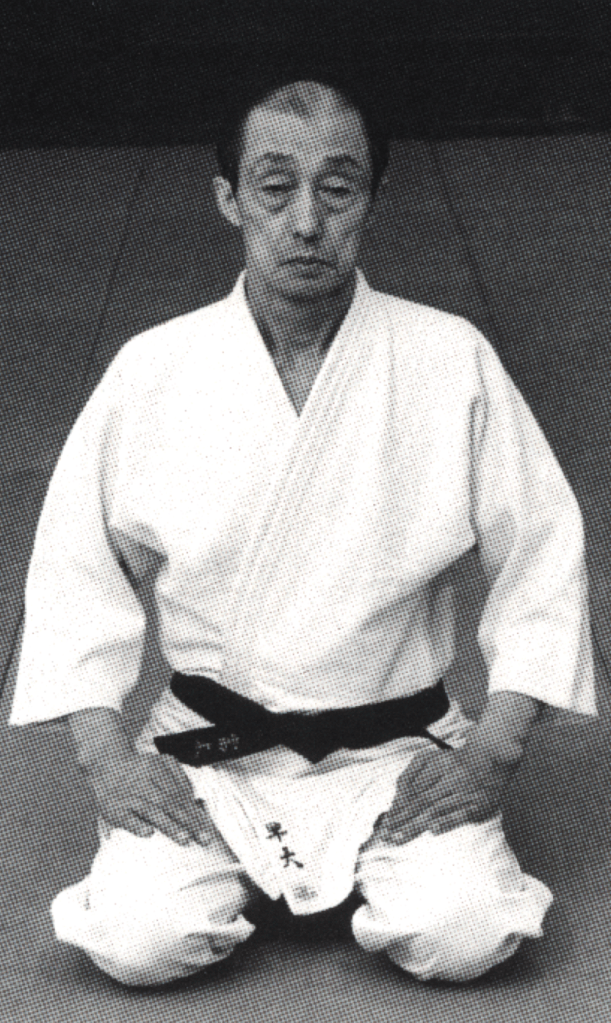
Kenji Tomiki is born on 15 March 1900 (Meiji 33) in Kakunodate, district Semboku, prefecture Akita, as the eldest son of Tomiki Shōsuke. Around the age of six he begins suburi (swinging exercises with a wooden sword); around ten he joins the local judo hall. His father long refuses to let his precious eldest son move on to middle school; only thanks to the intervention of his uncle, the Japanese-style painter and tanka poet Hirafuku Hyakusui, does Kenji enter the prefectural middle school of Yokote (1913). There he distinguishes himself in the judo club and receives two awards upon graduation. In November 1919 he obtains his first dan in judo, after which more than three years of illness and convalescence follow, once again supported by Hyakusui. Living in Hyakusui’s house he learns, beside letters and martial arts, calligraphy and painting; this formation repeatedly lends his later theorising an artistic register (the 1943 essay “Form and Principle” compares kata with the “six laws” of Chinese painting). Calligraphy of his hand survives from the age of fourteen (kept in Kakunodate and Yokote), and in 1929 the Waseda judo club, with his second brother Kenzaburō, makes an American tour under captain Kasahara Iwao.
After the preparatory department he studies from 1924 at the faculty of political science and economics of Waseda University, in the golden age of the Waseda judo club. As a board member of the Tokyo Student Judo Federation he comes into contact with the teaching of Kōdōkan-shihan Kanō Jigorō. Tomiki is known as the “bookworm of the judo club” and later as “the intellectual of the sports department”.
The meeting with Ueshiba and the early thinking (1926–1935)
In the autumn of 1926 (Taishō 15) Tomiki, through acquaintances in the network of admiral Takeshita Isamu, meets the Daitō-ryū master Ueshiba Morihei (that is the dating of the year-chronicle and of the archival research of Shishida and Kudō). In the round-table book 合気道と柔道 (2016) Tomiki remembers himself as 1927: graduation, his stay in Ayabe in the summer, and Ueshiba’s definitive settlement in Tokyo in the autumn of that year. Both the book and the literature flag this as contradictory (see the contradictions table).
The meeting is decisive. Ueshiba’s technique consists precisely of what had been banned from judo randori: kansetsu-waza and atemi-waza. In January 1928 (kagami-biraki) follows the fifth dan Kodokan, together with Hamano Shōhei and Sone Kōzō. (The older standard biography held that he was 4th dan during his student years; the 1928 letters and the round-table book place the 5th dan in January 1928 and tip the discussion.)
In 1928 Tomiki writes two letters which form the starting point of his technical theory (Kudō 2016): the letter to admiral Takeshita (19 September 1928, sent from Hirosaki during his military service) and the letter to the writer Nakazato Kaizan (May 1928). The core: budō is one path; the finest forms of every discipline come down to the same (“handle a sword with judo principles and you get kendō”); Kodokan judo has narrowed into a grappling form; Daitō-ryū fills precisely that gap; and the formulation “kata that are simultaneously randori”: adaptable forms, not petrified kata, is already fully present here. The Takeshita diaries document the intense contacts (among others the jujutsu training of 14 November 1927 with Takeshita’s daughter Misao; the temporary stop because of military service on 18 January 1928) and the letter of receipt of 21 September 1928. Through this network Takeshita’s daughter Misao receives in February 1928 the “Aioi aiki-jūjutsu hiden mokuroku” from Ueshiba (artist’s name Moritaka); the name line Daitō-ryū → Aioi-ryū (1928) → aiki-bujutsu (1929) → aiki-budō (ca. 1931) → aikidō (1942) runs through this dossier as well.
In 1929 Tomiki, as the representative of prefecture Miyagi, wrestles at the first Tenran-shiai (tournament in the presence of the emperor, on the occasion of the enthronement ceremonies): four bouts, among them victories with de-ashi-barai and tsurikomi-goshi and a loss against the groundwork prodigy Sekiguchi: his last competitive match. From 1931 he teaches civics at the middle school of Kakunodate, where he meets Ōba Hideo, assistant judo instructor: the beginning of a lifelong master-pupil relationship. Ōba becomes his only partner in the modernisation of aikido and later the second president of the JAA.
In 1930 Kanō Jigorō, guided by Takeshita, visits Ueshiba’s dōjō (“This is indeed judo”) and sends two pupils (among them Mochizuki Minoru; the second name is uncertain in the sources) to study there. In 1934 Tomiki resigns his post, moves close to Ueshiba’s house and devotes himself entirely to aiki-bujutsu.
Manchuria: the laboratory (1936–1945)
In the spring/May of 1936 Tomiki leaves for Manchukuo. At the farewell in the headmaster’s room Kanō speaks the words that become Tomiki’s life mission: “Tomiki-kun, techniques such as you practise with Ueshiba-san are necessary. The old jūjutsu all did what Ueshiba-san does. But how one should train that, that is the problem.” Meanwhile Nangō Jirō, Kanō’s nephew and second Kōdōkan director, had already started a “study committee on techniques in separated posture” (rikaku-tai); in his own memory Tomiki became the guinea pig in Nangō’s bōgu experiments of the war years: unarmed against a Takudai student with shinai, with meagre results (one successful parry in five attempts). That same experience leads to the thought that evading bare-handed must be possible against a tanto as well: the germ of the later tanto randori.
At Kenkoku University (Changchun) aikibudō becomes a compulsory subject alongside kendo and judo, with Ueshiba as advisor (recommended to the Kwantung Army by Hiraizumi Kiyoshi) and Tomiki as permanent lecturer (February 1939 associate professor after teaching from the founding year 1938; full professor at the end of 1941). His rational teaching method, set against Ueshiba’s intuitive “great way”, makes aikibudō accessible to ordinary students; witnesses speak of “irrationalism versus rationalism”, and Dodo Kazu characterises the pair as: Ueshiba = founding patriarch, Tomiki = apostle-propagator. At Kenkoku, Tomiki develops his own open technique names (oshi-taoshi, hiki-taoshi, kote-hineri, kote-gaeshi, shōmen-ate, ai-gamae-ate): modernising nomenclature on the model of seoi-nage.
On 11 February 1940 (Kigensetsu) Tomiki receives from Ueshiba, as the first in the world, the eighth dan of aikibudō (together with uchideshi Yukawa Tsutomu). “From that moment I began all sorts of innovations”: the awakening of a modern, competition-ready aikido. In 1941 follows the sixth dan in judo. His publications of these years form the birth certificate of the later system: the “Aiki-Bujutsu Kyōtei” (1937, for the military police), the article series “The future of judo and aiki-budō” (1937/1938; ken no ki and ju no ri as the first concrete filling-in of Kanō’s seiryoku zen’yō), and above all the “Systematic research of techniques in separated posture” (1942): six principles (sen, metsuke, kamae, unsoku, ma-ai, kuzushi/kake) and twelve basic techniques. The Kempeitai manual “Taijutsu Kyōjō” (1943) also contains his contribution, next to that of Ueshiba.
In 1945 Tomiki is called up for military service; after the Japanese capitulation he is interned by the Soviet Union near Lake Balkhash in Siberia. There too, orally and in thought, he forges his future budō concepts (among others the germs of his later system-building, including the randori-no-kata).
Reconstruction and system-building (1948–1958)
At the end of 1948 Tomiki returns. The postwar landscape: the Kōdōkan all but dissolved, judo banned from the schools. On the greeting of Ōhama Shinsen (“you come back at exactly the right moment”) Tomiki lands in the new university subject of physical education. He becomes permanent secretary of the Kōdōkan (1949–1954) and co-organiser of the All-Japan judo championships and of the re-founding of the Tokyo Student Judo Federation. (In the knowledge-base article on the randori method he is called “permanent board member of the All Japan Judo Federation until 1959”; see the contradictions.)
From 1951 he is a permanent lecturer at Waseda and shihan of the judo club. He forges his postwar theory mainly in judo teaching: he would lecture an hour of atemi and kansetsu-waza after training, which earns him the criticism that Waseda loses matches because of it. In November 1950 the little “tebiki” booklet appears (ten kihon techniques); from 1952 the Judo Taiso (“judo gymnastics according to judo principles”, published 1954, Inmon-dō, with a foreword by Kanō Risei) becomes a practical course subject at Waseda: the book Eddy Wolput translated into English.
In 1952–1956 Tomiki co-builds the Kōdōkan goshinjutsu (Shōriki initiative, 70th anniversary; secretariat Koyasu/Suzuki/Tomiki; presentation at the kagami-biraki of 1956 with Ōtaki Tadao as uke; publication 1958). In 1953 he teaches judo, with Kodani Sumiyuki and Ōtaki, on twenty-six bases in the United States. Meanwhile the “aiki-han” grows inside the Waseda judo club: Kawada Shin as the de facto, Ishizuka Sadao as the formal first group leader; from 1957 the group becomes more independent, and in 1958, when aikidō becomes a compulsory physical education subject, the aikidō club of Waseda University is officially recognised, under the express condition that the sportification of aikidō would succeed. Together with the publication of Aikidō Nyūmon (November 1958; kihon 15: 3 atemi, 4 hiji, 8 tekubi-waza) and the introduction of the “randori-shiki kata”/kakari-geiko as a bridge between kata and randori, this is the official starting shot of the competition research.
Competitive aikido and institution-building (1959–1979)
In 1959–1960 the aiki randori-hō crystallises as the “second randori method” of judo: bōgu is rejected (after trials), the first cautious toshu randori with self-imposed restraint (touching the chin = ippon) becomes practice; in 1960 Tomiki presents the method at the congress of the Japan Society of Physical Education. Along the research line kakari-geiko → hikitate-geiko → randori-geiko the competition method emerges; Kokushikan and then Seijō join Waseda, and thus the league of three universities grows. From “Aiki News” and the memorial volume the dossier knows: toshu randori later evolved into tanto randori (the transition carried by Nariyama and the club), occasioned by the problem of the thrusting attack; the three uki-waza (mae-otoshi, sumi-otoshi, hiki-otoshi) are formally fixed between Aikidō Nyūmon (15 techniques, 1958) and Shin Aikidō Tekisuto (17 techniques + 10 ura forms, 1963; the book’s chronology says 1964, see the contradictions).
Institutionally: 1964 member of the examination committee for teaching credentials (Ministry of Education) and competition official at the Tokyo Olympic Games; 19 April 1969 seventh dan Kodokan judo (diploma photo in the memorial volume); 1970 retirement from Waseda (emeritus), publication of Taiiku to budō (1970), the first All-Japan Student Aikidō Championship and the beginning of the competitive league; 1971 eighth dan judo; 1970/1974 founding of the Japan Aikido Association (JAA) with Tomiki as president (dating disputed, see the contradictions); 1976 founding of the central dōjō, the Shōdōkan, in Osaka (Tomiki as kanchō); 1977 a journey to Australia at the invitation of the Australian aikidō federation; from those years he is vice-president of the Nippon Budō Gakkai. In 1975–1977 his late programmatic texts appear: the lecture Judo and Zen (1975), the lectures and essays in which he presents this as his answer to Kanō’s life mission, and the excerpt from The essence of judo (1977) with the thesis that the Kōshiki-no-kata forms the basis of aikido.
The round tables: around 1975–1979 Tomiki holds the recorded conversations that appear in 2016 as 合気道と柔道: on sport and budō, on Kanō and Ueshiba, on Zen and religion, on “the half that Kanō left undone”. The postwar chapter of his thought ends with the image of “aikidō too in every judo hall of the world” and the ideal of mushin mugamae (the empty mind, the postureless posture) as the educational end point, summarised in his competition theory (atemi typology into physiological versus mechanical weak points; restriction of the kime-kata; union of the kendō and judō principles). His final lecture, “Love of education” (教育愛, 1970), counts as his educational testament; on 25 December 1979 Kenji Tomiki dies at seventy-nine years of age. The in-memoriam in Budōgaku Kenkyū 12-2 (1980, by his successor) remembers him as the researcher who applied the full arsenal of judo to aikido; Dodo Kazu saw, at his last visit (Kobe, June 1979, with Nariyama), “the quiet, weathered presence of an ascetic”.
The core of his legacy
Tomiki’s life project in one sentence: to explain and train the old jūjutsu according to the principles Kanō gave to judo, and in such a way that atemi and kansetsu-waza (the “separated posture”) can carry a randori and finally a competition. His instruments: the three judo principles (shizentai, jū, kuzushi), tsukuri and kake, sen, metsuke, ma-ai, unsoku, and the tegatana as the connecting point between kendō riai and judo technique; kata and randori in one continuous training path; and the conclusion that Kanō “left half undone”: the grappling form got its competition, the “rikaku-tai” remained without an experimental field, and without an experimental field technique degenerates into chanbara.
Contradictions in the sources
First meeting with Ueshiba
autumn 1926 (chronicle of the 2016 book; Shishida; Kudō)
1927 (Tomiki’s own oral memory: “this year exactly fifty years ago”)
Both “true”: 1926 = first acquaintance (demonstration at Takeshita’s); 1927 = start of the actual apprenticeship; the book literally contradicts itself
5th dan Kodokan
January 1928, kagami-biraki (2016 book; May 1928 letter “5th dan”)
4th dan during his student years (older standard biography)
Book and letters tip the discussion in favour of 1928
Shin Aikidō Tekisuto
1963 (Shishida’s bibliography; uki-waza article; Sangenkai)
1964 (chronicle of the 2016 book)
1963 is better documented (Inmon-dō, June 1963)
Founding of the JAA
1974 (chronicle of the 2016 book)
“definitive founding 1970”, the year of the first All-Japan student championship (Sangenkai)
Possibly 1970 = competition league/precursor, 1974 = formal corporate body; unresolved
Kōdōkan goshinjutsu
commission at the 70th anniversary 1952 (2016 book); presentation 1956
compilation 1954 with Kodani (Sato 2011, HIDEN)
No hard contradiction: different phases (request 1952, fixation 1954–56, publication 1958)
Seiryoku zen’yō kokumin taiiku
first presentation 1927 (2016 book, twice; also the HIDEN special 2015)
publication 1930 (standard literature)
Possibly 1927 = design, 1930 = publication; the book deliberately repeats 1927
Takeda/Ueshiba chronology
Ueshiba to Hokkaidō ca. 1912, meeting Takeda 1915 at Engaru, departure 1919 (standard dating)
Both ca. 1910; meeting “Taishō 2–3 or 4?”; departure 1917–18 “or Taishō 8?” (Tomiki’s memory, chapter 3)
A memory drift of ± 2 years; the book itself already marks it with [?]
Horikawa Kōdō lives in
Abashiri (most literature)
Kitami (2016 book)
Possibly swapped with the Daitō-kan of Takeda’s son (Abashiri); to be verified
Kodokan dan grades
7th dan 19 April 1969 (diploma photo, memorial volume 2001)
the 2016 chronicle jumps from 5th dan (1928) to 8th dan (1971)
Complementary: 6th dan 1941, 7th dan 1969, 8th dan 1971; the book does not mention the intermediate grades
Postwar Kōdōkan office
permanent secretary of the Kōdōkan 1949–1954 (2016 book)
permanent board member of the AJJF until 1959 (Shishida 1982)
Two different offices (Kōdōkan vs. All-Japan Judo Federation); both sources may be right
Ueshiba’s resistance to competition
“he resisted outright” and boycott (Tomiki himself, 2016 book)
Morihei never forbade Tomiki anything; organisational boycott only after 1969 under Kisshōmaru; the 1970 Osaka compromise; the 1977 name-change offer (Sangenkai/Rising Dragons)
Tension between witness source and archive; presumably: randori tolerated, point-scoring competition rejected on principle, the break organisational only after Morihei’s death
Judo Taiso publication
1954, Inmon-dō (bibliography)
none
Unambiguous; for reference only
Finally, the whole is strongly supported by the rich archival dossier Eddy Wolput has carefully built since 1980 inclusive (the Takeshita diaries and hiden, Shishida’s research series 1980/1981/1982/1992, Kudō 2015/2016, the prewar letters, the Kenkoku chapter, the 2001 centenary volume, the 2015 HIDEN special, Aiki News 128, Sato 2011, the 1990 uki-waza article, and the complete translation of 合気道と柔道 2016).

